Solving the Unbuildable Brief
Every extraordinary structure begins as an unbuildable brief. Between the architect's conceptual render and the ribbon-cutting ceremony lies a sequence of engineering obstacles that push human technology to its absolute limit.
1. The Geotechnical Reality: Friction Piles in Fragile Ground
In cities like Dubai, Shanghai, or Saint Petersburg, bedrock does not lie near the surface. Megastructures must often be erected on marine silt, soft clay, or porous carbonate sands. Under these conditions, the foundation cannot rest on solid stone; it must rely entirely on skin friction.
During the foundation work for the Burj Khalifa and Merdeka 118, civil engineers bored hundreds of friction piles over 100 meters deep into subterranean strata. High-pressure grout was pumped under the pile toes to compact surrounding soil. The resulting pile-raft system acts as a unified monolithic block, spreading hundreds of thousands of tons of vertical mass so evenly that differential settlement is limited to mere millimeters.
"If one quadrant of a 600-meter tower settles just 20 millimeters more than the opposite quadrant, the building's crown can tilt by more than a meter out of plumb."
Foundation Engineering Practice Guidelines2. Pumping Concrete to Cloud Level
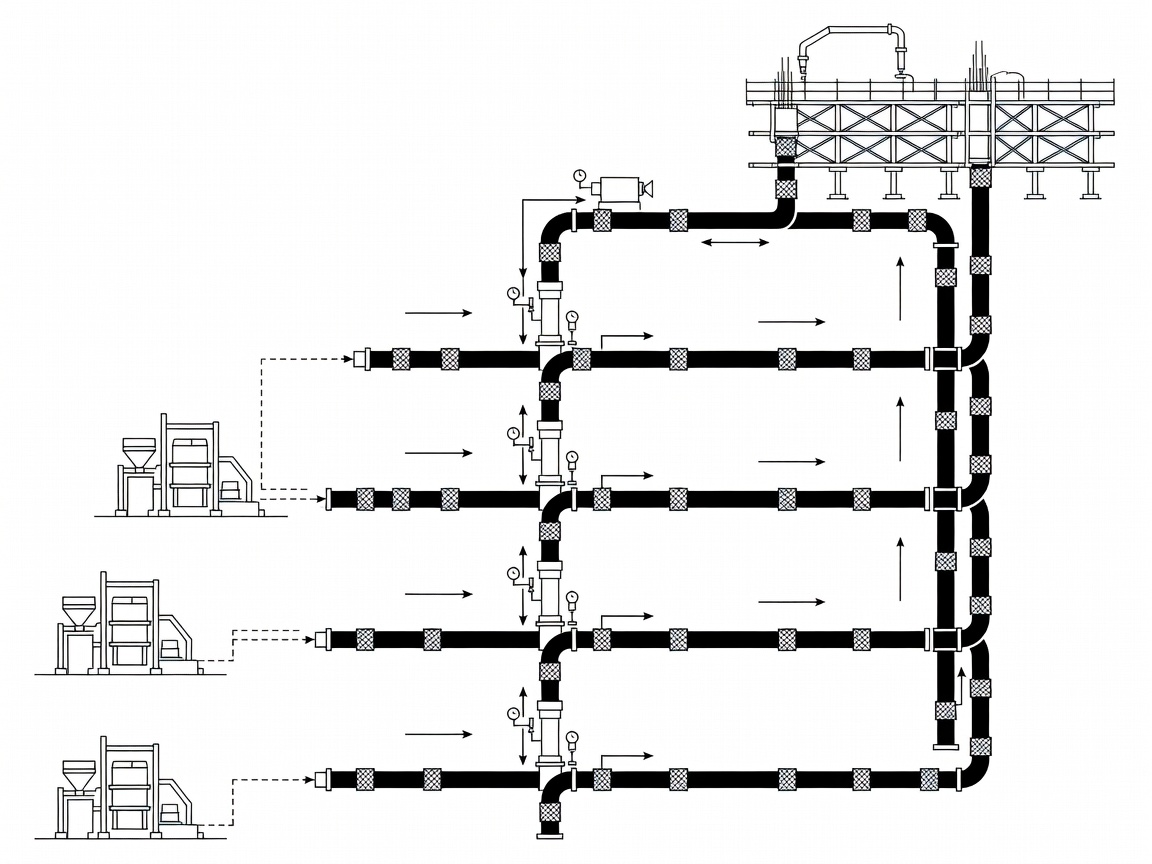
A skyscraper cannot be assembled entirely from pre-manufactured structural steel. Heavy core shear walls require massive continuous pours of in-situ concrete. But how do you pump thousands of metric tons of wet liquid stone 600 meters straight up through a narrow pipe?
The solution requires custom hydraulic high-pressure concrete pumps generating pressures upward of 300 bar. At these pressures, standard concrete would segregate, forcing water out and leaving aggregate jammed in the pipe. Specialized superplasticizers and chilled water mixes are calibrated to ensure the concrete remains liquid during its 40-minute vertical ascent, yet cures to full 100-MPa strength once cast into forms.
3. Seismic Isolation at Unprecedented Scale
Building in active subduction zones—such as Tokyo, Taipei, or Istanbul—requires decoupling the building's upper structure from ground motion. In mid-rise buildings, elastomeric rubber bearings under the basement suffice. In megastructures, however, the sheer overturning moment would tear standard rubber bearings apart.
Engineers solve this through triple friction pendulum bearings. These devices utilize curved stainless steel concave sliders that allow the entire structure to sway smoothly like a pendulum during an 8.5-magnitude earthquake, absorbing seismic ground acceleration while limiting the forces transmitted into the superstructure above.
4. The Stack Effect: Thermal Pressure Differentials
In cold-climate supertall towers (such as in Chicago or Toronto), the temperature delta between icy outside air and heated interior air creates immense vertical air pressure: the stack effect. Air rushes into ground-level doors with hurricane force and pushes violently outward at upper elevator shafts, jamming doors and risking smoke distribution during a fire.
Mitigating this requires complex vertical air compartmentalization: revolving airlocks, pressurized intermediary mechanical zones, and precision HVAC control that balances air pressure across every twenty-floor block independently.