Infrastructure: Systems That Reshape Distance
While landmark towers capture the public imagination, subterranean and maritime infrastructure megaprojects quietly reconfigure the economic geography of entire continents.
Subsea crossings, mountain base tunnels, and high-speed maglev lines operate under constraints far harsher than atmospheric buildings. They contend with continuous hydrostatic pressures exceeding 40 atmospheres, active tectonic plate shear lines, and internal thermal gradients requiring dedicated cooling infrastructure.
"In subsea tunnelling, success is not defined by digging speed, but by water exclusion. A single ruptured gasket 40 meters beneath the sea floor can flood an 18-kilometer corridor in minutes."
Marine Civil Engineering ReviewThe Immersed Tube Revolution: Fehmarnbelt
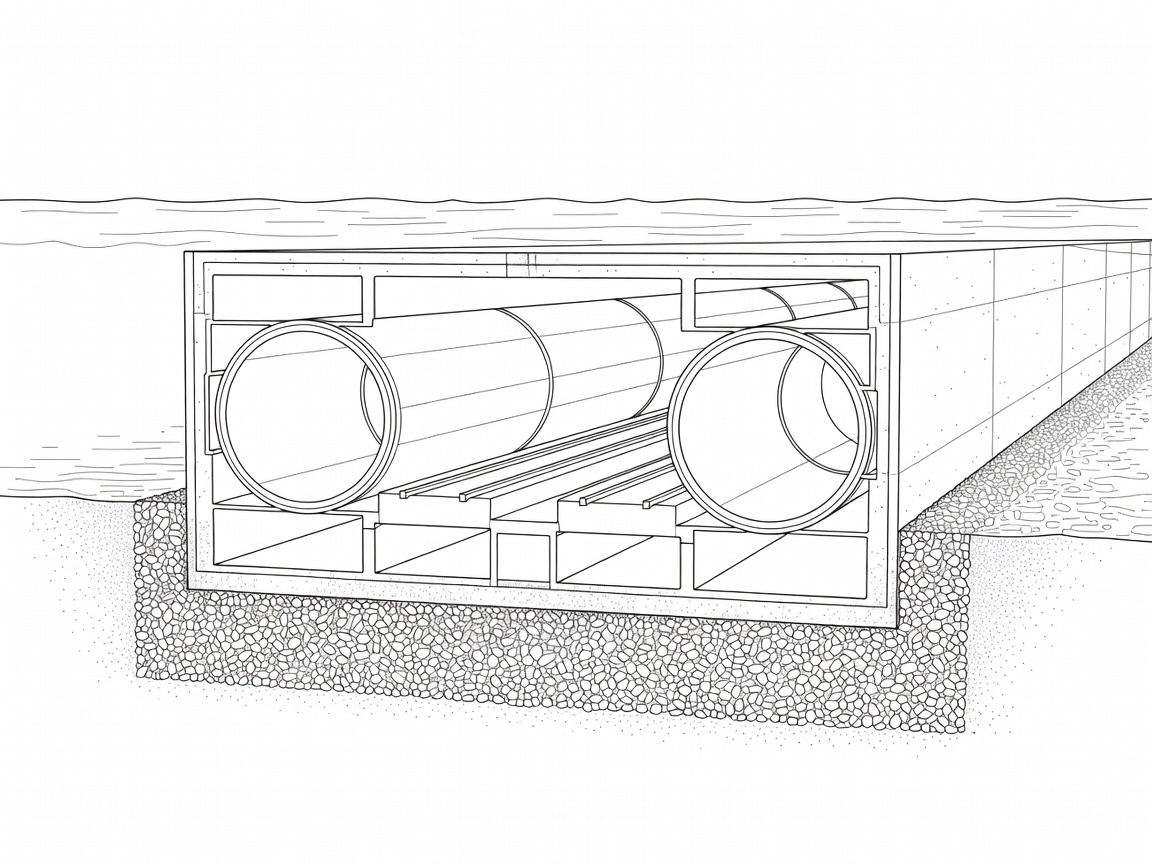
Connecting the Danish island of Lolland with the German island of Fehmarn, the 18-kilometer Fehmarnbelt Fixed Link is the world's longest immersed tunnel for combined road and rail traffic. Unlike bored tunnels that utilize tunnel boring machines (TBMs) deep in geological bedrock, the immersed approach uses industrial dry docks to cast massive reinforced concrete tunnel elements.
Each standard element measures 217 meters in length and weighs approximately 73,000 metric tons. Once sealed with temporary bulkheads, they are floated out into the Baltic Sea, positioned by GPS-guided positioning barges, and lowered into a pre-dredged trench on the sea floor with sub-centimeter tolerance.
Boring Through Tectonic Faults: The Gotthard and Brenner Baselines
Across the European Alps, baseline tunnels represent a fundamental shift: instead of climbing mountain passes with steep gradients, tracks bore flat through the base of the mountain range. The 57-kilometer Gotthard Base Tunnel was bored under rock overburden of up to 2,300 meters, where rock temperatures reached 46°C and crushing pressures deformed steel support arches like tin foil.
Engineers managed dynamic rock bursts by injecting expanding resin grouts and utilizing flexible radial support rings that yield slightly under immense geological strain without collapsing the main concrete liner.
High-Speed Magnetic Levitation Corridors
Japan’s Chuo Shinkansen SCMaglev project between Tokyo, Nagoya, and Osaka takes civil infrastructure into superconducting territory. Operating at operational speeds of 505 km/h, the train levitates 10 centimeters above a U-shaped concrete guideway using niobium-titanium superconducting magnets cooled by liquid helium.
Because aerodynamic resistance increases with the cube of speed, approximately 86% of the 286-kilometer first phase is routed through deep mountain tunnels. The precision required for the guideway is extreme: civil contractors must maintain concrete pouring tolerances within 2 millimeters over hundreds of kilometers of subterranean tunnel.